A tender is decided on the criteria in front of you. If the carbon a project will emit is not one of them, it does not lose. It simply does not compete. The bid that burns through a few hundred extra tonnes of CO₂ arrives on the evaluation sheet looking like the better deal, because the part that makes it worse was never priced.
Procurement professionals want to contribute to their city's climate plans from their own role, and many already do. The difficulty is rarely ambition but turning that ambition into award criteria that are concrete, defensible and easy to validate.
This two-part series looks at the emissions of buildings and infrastructure projects through the lens of public procurement. Experts from the Interreg North-West Europe project DeCarb-Pro explain how a tonne of CO₂ can be given a value, how that value behaves once it enters a procedure, and what stands in the way of using it. The first session sets the scene and collects the barriers participants recognise from their own work. The second session takes those barriers as its starting point and moves to implementation.
The two sessions are designed to be followed together, and each one requires its own registration. Sign up for both to follow the complete series:
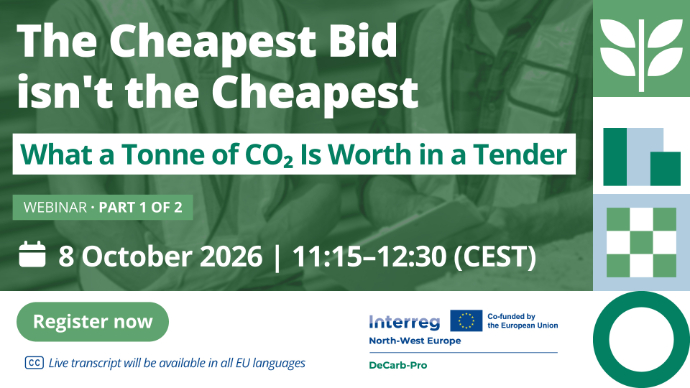
What a Tonne of CO₂ Is Worth in a Tender
Webinar - Part 1 of 2
8 October 2026, 11:15 – 12:30 (CEST)
Register Now | Webinar - Part 1
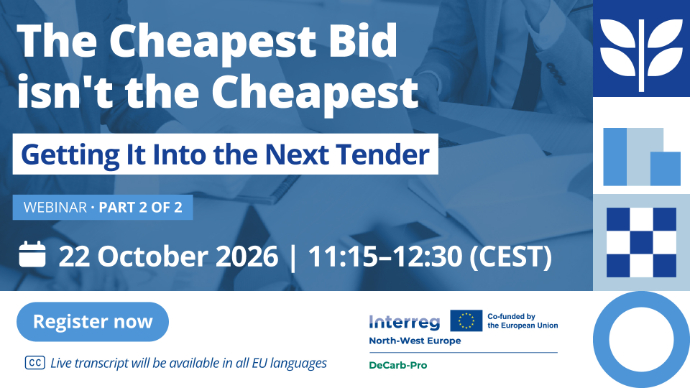
Getting It Into the Next Tender
Webinar - Part 2 of 2
22 October 2026, 11:15 – 12:30 (CEST)
Register Now | Webinar - Part 2
Live transcript will be available in all EU languages.
Participation is free of charge, thanks to the support of the Interreg North-West Europe programme.
Everyone who registers is also invited to the DeCarb-Pro Final Event in Brussels on 5 November.
Webinar 1/2
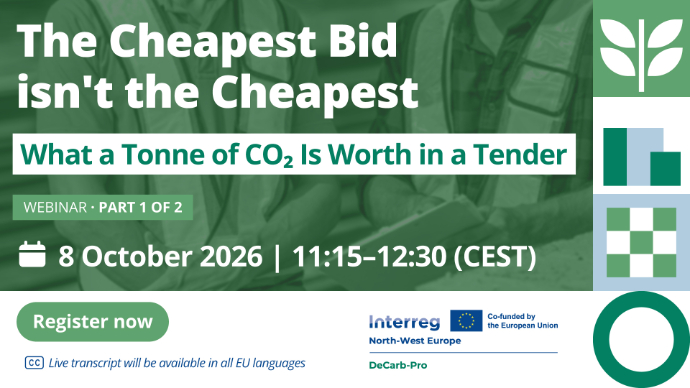
What a Tonne of CO₂ Is Worth in a Tender:
Thursday 8 October 2026, 11:15 – 12:30 (CEST)
Imagine this: two bids come in for the renovation of a school building. One is cheaper. The other uses a low-carbon concrete mix and reuses part of the existing structure, and would save several hundred tonnes of CO₂ over the life of the project. On the evaluation sheet, that difference is worth nothing. Unless you gave it a value before the tender went out.
So what is a tonne of CO₂ worth? There is more than one honest answer, and the answer you choose changes which bid wins.
This first session works through those answers. It covers the fundamentals of measuring emissions in construction and civil works, the different methods available for valuing them, and how each of those methods behaves once it has to survive a procurement procedure and a possible challenge. It also looks at the ground shifting under public buyers right now, from European reporting requirements to the growing weight of environmental criteria in awarding, and what that means for the people writing the specifications.
You do not need an economics background to follow along. The session is designed for procurement professionals, contract managers, category managers and the policy advisors who work alongside them, particularly those working on buildings, civil works and infrastructure.
A short live poll (Mentimeter) will ask where the obstacles sit in your own organisation. Those answers are not a warm-up exercise: they set the agenda for the second webinar, which starts from the barriers this group names.
Live transcript will be available in all EU languages.
What to expect
11:15 | Digital check-in
11:30 | Webinar starts
Topics include:
- CO₂ fundamentals
- Introduction to the DeCarb-Pro project
- Different ways to value CO₂ emissions
- The changing environment of public procurement
- Live poll: what are the barriers to using carbon pricing?
- A success story from a DeCarb-Pro pilot
- Questions and discussion
12:30 | End of webinar
You will leave knowing which method of valuing emissions fits which kind of decision, what each one demands of you in practice, and where the friction tends to appear. The second webinar then turns to the harder question: how do you get it into an actual tender?
Speakers
- Bengisu Izat, Stadt Essen. Bengisu is a project manager for DeCarb-Pro at the City of Essen, which has committed to climate neutrality by 2045 and treats public procurement as one of the main levers for getting there. She comes to the subject from the technical side, with a background in environment and energy and earlier work at Fraunhofer UMSICHT and in the energy sector.
- Juliette Gautier, Ville et Eurométropole de Strasbourg. Juliette works for the City and Eurometropolis of Strasbourg, where climate and procurement strategy are being connected through carbon pricing: new carbon criteria in tenders, from roadworks to water infrastructure projects, alongside supplier workshops and internal alignment across departments. She is an engineer by training, having studied at INSA Lyon.
Register here
Webinar 2/2
Getting It Into the Next Tender
Thursday 22 October 2026, 11:15 – 12:30 (CEST)
Imagine this: you are convinced. You can put a number on a tonne of CO₂, you can explain the reasoning to a colleague, and you can see roughly where it would sit in an evaluation. Then the meeting ends and the question turns concrete.
Which contract do you raise it in? Who has to agree before it can go in? And what do you say when someone asks whether it will hold up, or where the figure came from??
The first session was about what the number is worth. This one is about getting it into the next tender.
Mélanie Baudin and Bengisu Izat will draw on real cases from public organisations that have integrated carbon pricing into their procurement processes: what they did, what went wrong first, and what turned out to matter most. Rather than presenting one model to copy, the session offers a step-by-step approach and a set of entry points, so participants can find the one that fits their own role, mandate and resources. The barriers named in the live poll during Webinar 1 are the starting point for the discussion.
The closing part of the session is about you specifically. Not every procurement professional sits in the same position. Some can change a specification directly, others can only put a question to a project team, and both of those are real contributions. Through a short "characters" exercise, participants identify which position they occupy and what leverage it actually gives them.
By the end of the session, you should be able to answer one question: what can I do next to support the integration of carbon pricing into procurement in my organisation?
Time is reserved for questions and cases from participants, with project partners responding and fellow participants sharing their own experience.
Live transcript will be available in all EU languages.
What to expect
11:15 | Digital check-in
11:30 | Webinar and Q&A
Topics include:
- Recap of the key concepts from Webinar 1
- The barriers you named, and what sits behind them
- Practical examples from public organisations that have applied carbon pricing
- Lessons learned and critical success factors
- A step-by-step approach to introducing carbon pricing in procurement
- Entry points for action with limited resources or decision-making authority
- Defining your next step: which "character" are you, and what can you move?
- Questions, discussion and exchange of experiences
12:30 | End of webinar
You will leave with key messages worth taking back to your organisation and a concrete next step you can take yourself, whatever your level of influence.
Speakers
- Mélanie Baudin, Ville de Paris. Mélanie is a project manager for green budgeting and DeCarb-Pro coordinator at the City of Paris, where carbon pricing is being applied to the city's major procurements, starting with road infrastructure contracts. Much of her work goes into the complementarity between technical expertise and human collaboration, without which none of it can move forward: the internal tools and indicators needed to track climate investments, as well as cross-departmental cooperation. She is a consistent advocate of the step-by-step approach around which this session is built.
- Bengisu Izat, Stadt Essen. Bengisu is a project manager for DeCarb-Pro at the City of Essen, which has committed to climate neutrality by 2045 and treats public procurement as one of the main levers for getting there. She comes to the subject from the technical side, with a background in environment and energy and earlier work at Fraunhofer UMSICHT and in the energy sector.