Champion Spotlight
Behind every successful CO₂ pricing pilot is a person who made it happen.
DeCarb-Pro spotlights one practitioner, one project, one story.
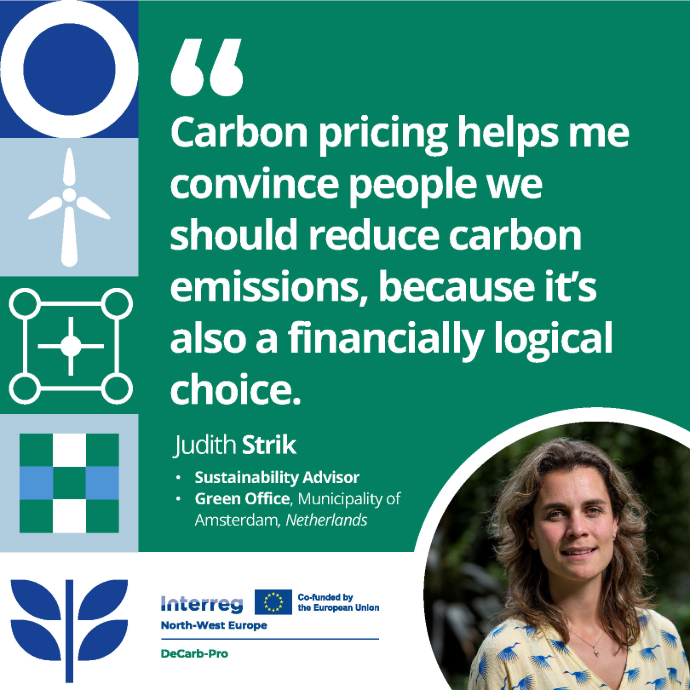
Champion Spotlight — Municipality of Amsterdam
Judith
Strik
Sustainability Advisor · Green Office, Municipality of Amsterdam
Focus
1 internal
carbon price
for the municipal organisation, from project design through execution to monitoring
Made visible
1 in-house
tool
a simple calculator, plus examples like true-pricing the city's coffee beans
By 2030
A sustainable
organisation
the target Amsterdam has set for itself, the reason the financial side had to be solved
The problem worth solving
Amsterdam has sustainability goals and strong political commitment behind carbon pricing. What it lacked was a way to act on them where the money is decided. Financial decisions and sustainability ambitions ran on separate tracks, so Judith set out to bring sustainability inside the financial processes themselves.
What she actually did
Most of the work was persuasion. Carbon pricing stays abstract until people can see the number, so Judith made it visible: an easy tool to calculate the price, and recognisable examples - the municipality's coffee beans, priced using the concept of true pricing.
The chain of departments runs wide - design, execution, monitoring - but finance is where the concept has to land. The field itself is young: few resources exist, and there is no consensus yet on the right price level. DeCarb-Pro gave Amsterdam the support to build its own.
What changed
Work in progress, by design. Some investment choices have already come out differently because the carbon price was in the calculation - electric vehicles instead of fossil-fuel ones.
The deeper shift is in attitude. More colleagues see the value of the concept, and more are curious enough to test it on their own projects - which is how it moves from policy into practice.
For those just getting started
"Start discovering the concept with curious colleagues! And read the strategy of DeCarb-Pro for all the practical tips."
— Judith Strik, on advice for beginnersWhat worked and what didn't
What worked: starting small. Explain the concept, offer easy examples, and let curiosity do the rest. When someone asks for the next step, help them build the carbon price into their own project, which only works if a practical guideline or tool is ready.
What Judith would do differently: start smaller still. The policy department spent a long time on the concept and produced a very elaborate tool. She would rather begin with one or two live projects and let them reveal which tool is actually needed.
What's next
More testing, across different projects, as the work on sustainable investment continues. Going further needs political support, internal capacity, and knowledge exchange with other municipalities of the kind DeCarb-Pro provides.
I got really inspired with all the smart people in DeCarb-Pro. I learned a lot from the willingness and curious attitude from the partners in all countries. To work with this new concept of carbon pricing, I believe that's essential: to be curious and enthusiastic!
— Judith Strik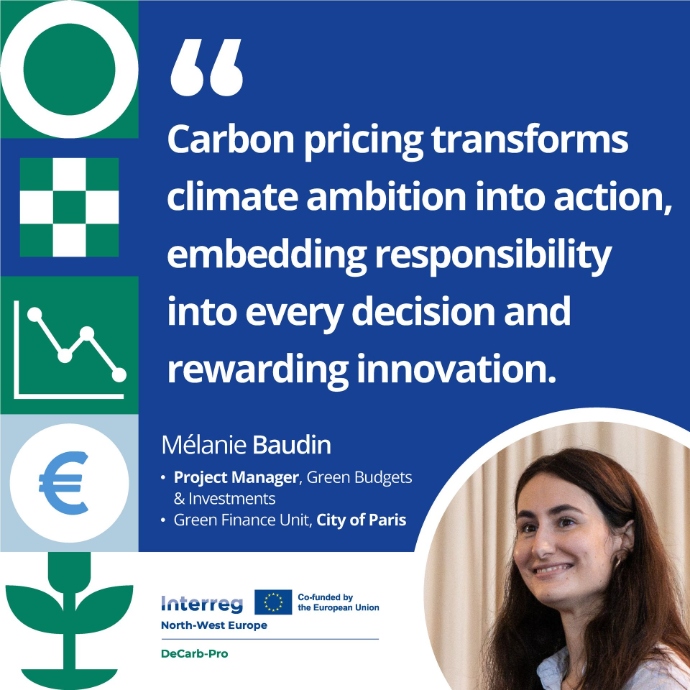
Champion Spotlight — City of Paris
Mélanie
Baudin
Project Manager, Green Budgets & Investments · Green Finance Unit, City of Paris
Focus
1 framework
agreement
on roadworks — the deliberately narrow starting point
Market maturity
3 / 4
suppliers already use SEVE-TP, the eco-comparator chosen for the pilot
From August 2026
National
mandate
carbon criteria required in every French public contract
The missing dimension in procurement
The city of Paris already had environmental criteria in its sustainable procurement plan. What it didn't yet have was a way to weigh carbon impact and financial cost in the same breath. Mélanie saw the opening: CO₂ pricing as the missing dimension in how bids get evaluated.
Aligning what already existed
The team expected to build CO₂ pricing from scratch. What they found instead was a constellation of decarbonisation initiatives already underway across departments — waiting to be aligned and consolidated. DeCarb-Pro became the convening force.
The approach was deliberately narrow: pick one project type (roadworks), map every carbon emission source within it, assign emission factors, then run the assessment through SEVE-TP — a free tool from the French National Federation of Public Works — to identify the most carbon-intensive elements. Lower-carbon alternatives were tested for technical, financial, and operational feasibility, then translated into procurement criteria with monitoring mechanisms and contractual incentives to back them up.
A market more ready than expected
Discussions with the four contract holders revealed a market more ready than expected: high maturity on SEVE-TP, three out of four with a dedicated person for it, and clear endorsement of the tool as a bid eco-comparator. The pilot has been written into Paris's 2024–2030 Climate Action Plan.
The deeper shift was internal. A large administration with strong interest but scattered expertise found a reason — and a project team — to coordinate. Climate, Finance, and Road Infrastructure Directorates now share a working language for carbon in procurement.
For those just getting started
"Drive change from the bottom up — start small, demonstrate success, and scale progressively. At the same time, craft a clear narrative around carbon pricing. Making it easy to understand is what unlocks broad support."
— Mélanie BaudinLessons from the field
The format that worked best: a two-hour workshop bringing carbon experts, procurement specialists, and project teams into the same room to map next steps together.
What Mélanie would do differently: start coordinating earlier. The team chose to focus on a single call-off contract for concreteness, but its drafting was already underway when the pilot kicked in — and the timing mismatch cost them weeks.
From pilot to replicable model
Replicability. The team is now examining how the roadworks pilot can travel to other framework agreements — with political backing and internal capacity as the conditions for scaling.
Connect on LinkedIn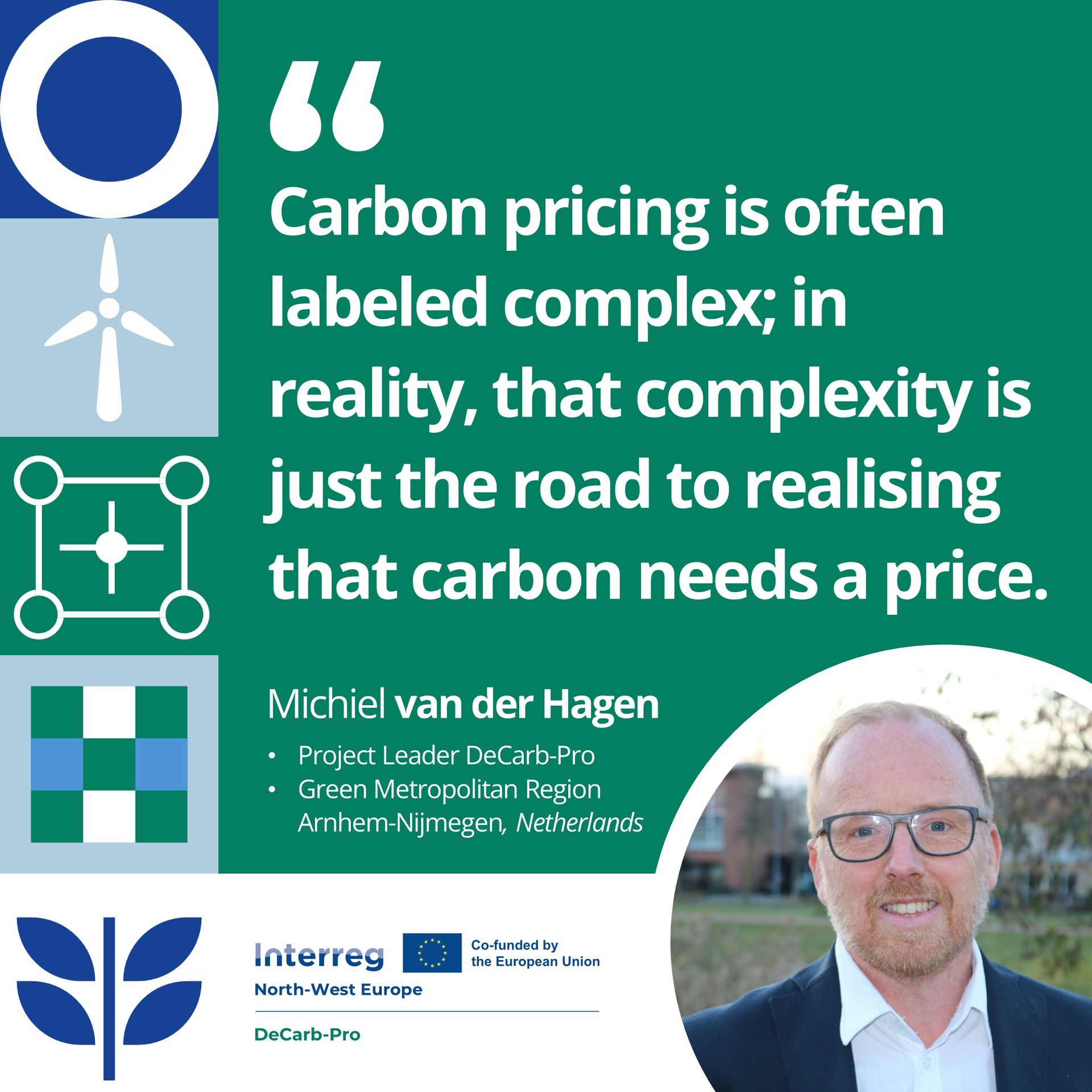
Champion Spotlight — Green Metropolitan Region
Michiel
van der Hagen
Policy Advisor · Green Metropolitan Region
Annual investment
€0.5M
in green energy across GMR municipalities
Climate damage avoided
€30M / yr
a 60× return on investment
Outcome
100%
of GMR municipalities switched to green electricity
Making the invisible cost visible
Climate impact is easy to ignore. It lives in the future, feels distant, and carries the convenient label of 'someone else's problem.' Michiel sees this daily: municipalities juggling competing priorities, with carbon consequences perpetually bumped down the agenda.
His starting point was simple but radical — what if you made climate costs visible in the present tense, in euros, today?
Turning values into numbers
Together with all the local municipalities of the Green Metropolitan Region, Michiel's team ran a pilot calculating the avoided climate damage costs of switching to green energy. They drew on energy consumption reports, CO₂ emission factors, and the Social Cost of Carbon price.
The result: a €0.5 million annual investment avoids €30 million in climate damage costs every year.
Putting the effect in euros made the decision simple.
— Michiel van der HagenA cultural shift, not just a policy win
Every municipality in the GMR chose green electricity. But the bigger shift was cultural: 'green' stopped being a values argument and became a numbers argument.
For those just getting started
"Just do it. It's not that difficult to calculate the costs once you have insight into your emissions. Yes, there will be debate about the price, but at least you're thinking about long-term effects."
Spreading the method across regions
Michiel is running trainings, sparking new pilots, gathering more good examples across North-West Europe.
Connect on LinkedIn